Category: AI & Automation
-

Build Python Multi-Agent Systems: Complete Setup Guide
By Andrii Klymenko · Updated August 04, 2026 Quick answer: A Python multi-agent system requires Python 3.10+, an LLM framework like LangChain or CrewAI, and an LLM API key. The minimum architecture includes an orchestrator agent managing specialized tool agents that share state through memory objects or message queues. Each agent handles a narrow task…
-
AI Automation for One-Person Business: Complete Setup Guide
By Andrii Klymenko · Updated August 02, 2026 Quick answer: To set up AI automation for a one-person business, start with four core processes: lead generation using Clay and Apollo, client onboarding with Zapier and Notion, reporting through Make and Google Looker Studio, and communication via ChatGPT API or Claude. These automations can free up…
-
Python Multi-Agent vs Single Agents: Scaling Guide
By Andrii Klymenko · Updated August 01, 2026 Quick answer: Use a multi-agent system when you have parallel independent subtasks or clearly distinct specialist roles. Single agents work best for linear workflows that fit within one context window. According to LangChain’s 2024 report, 68% of production agents fail due to incorrect task decomposition, making proper…
-

AI Automation Playbook for Solopreneurs: Full Setup
By Andrii Klymenko · Updated July 29, 2026 Quick answer: An AI automation playbook for solopreneurs is a step-by-step guide to map and automate recurring business tasks like email follow-ups, content scheduling, client onboarding, and invoicing. Implementing this framework typically frees 15+ hours weekly and increases net profit by 18-27% in the first year, requiring…
-
Build Python Multi-Agent System: Complete Guide
By Andrii Klymenko · Updated July 28, 2026 Quick answer: A Python multi-agent system consists of multiple autonomous AI agents with specialized roles that collaborate and communicate through a shared memory layer, rather than a single agent with tools. Each agent reasons about which actions to take, executes them, and observes results while an orchestrator…
-

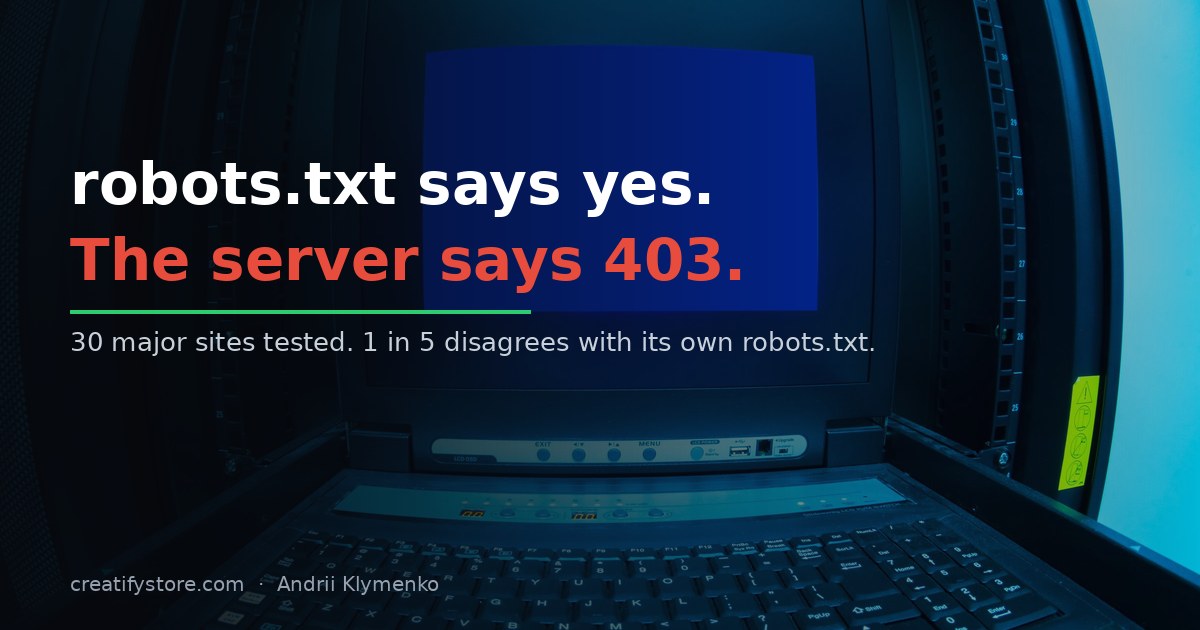
I Tested 30 Major Websites: 1 in 5 Does Not Serve the AI Crawlers It Officially Allows
Live requests as 12 AI crawlers to 30 major sites: 1 in 5 does not serve the crawlers its robots.txt allows.
-

Make vs Zapier 2026: Best Automation for Small Business
By Andrii Klymenko · Updated July 26, 2026 Quick answer: For small businesses, choose Zapier if non-technical staff will build and maintain automations, since it offers 6,000 app integrations and simple linear workflows with zero coding required. Choose Make if you have a technical operator who needs complex conditional logic and data transformation. Businesses exceeding…
-

I Built a Fully Autonomous AI Business. 111 Days, 149 Articles and 63 Cron Jobs Later, It Made $54.
By Andrii Klymenko · Updated July 26, 2026 At 4 a.m. on a Tuesday, my server published its 149th article. Nobody read it. I checked the logs anyway — all 138,099 lines of them — and everything was green. Every scheduled job had fired on time. Every module had done exactly what it was told.…
-
Notion OS Setup for Solopreneurs: Complete Guide
By Andrii Klymenko · Updated July 24, 2026 Quick answer: To set up a Notion OS for solopreneurs, build four linked databases covering daily tasks, projects, client CRM, and finances inside one workspace. Connect them relationally so client records link to projects, tasks, and invoices automatically. Start with a Command Center homepage that filters live…
-

Build Multi-Agent AI Systems in Python 2026
By Andrii Klymenko · Updated July 23, 2026 Quick answer: To build a multi-agent AI system in Python, you need an LLM backbone like GPT-4o or Claude 3.5, an orchestration framework like LangGraph or CrewAI, and specialized agents bound to specific tools such as web search or code execution. One orchestrator agent decomposes tasks, routes…